Lincolnshire Knee Clinic
Treatments

Total Knee Replacement

Resurfacing the entire damaged knee joint with metal and plastic implants to relieve severe pain and restore function.

On this page

Overview

Total knee replacement is a highly successful procedure for advanced, widespread joint wear. This page covers the surgery, suitability, risks, and recovery timeline.

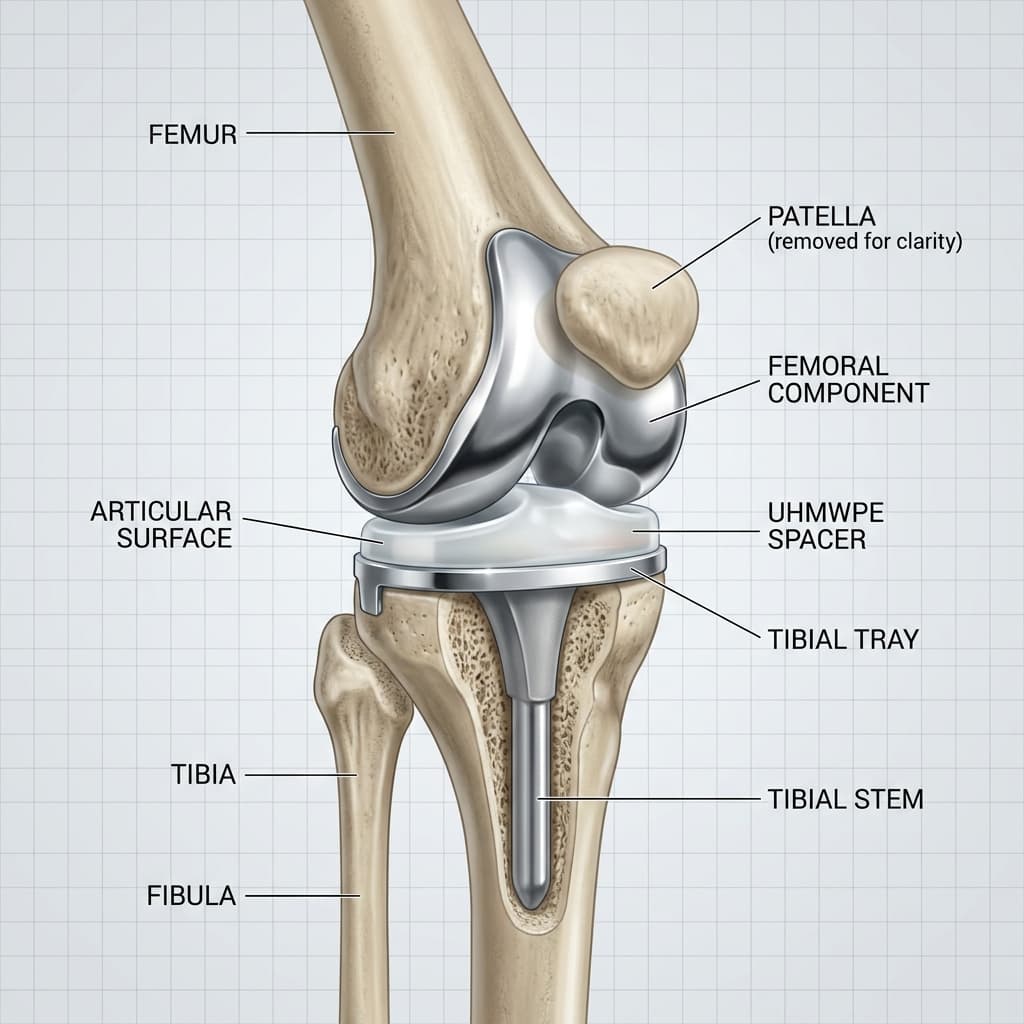
Total knee replacement (total knee arthroplasty) is a major surgical procedure where all three compartments of the damaged joint are resurfaced. The worn cartilage and bone ends are replaced with metal alloy components, and a durable plastic spacer is inserted between them to recreate a smooth joint. Wording is cautious: it is major surgery, and recovery requires active commitment.
This information is for general patient education and does not replace an individual clinical assessment. Suitability and outcomes depend on joint condition and physical health.

Clinical Overview Illustration

Diagram illustrating femoral component, tibial tray, and polyethylene spacer resurfacing the arthritic joint.
Tricompartmental total knee replacement showing prosthetic alignment..

What does this treatment involve?

Typical clinical stages of this treatment pathway include:

1Preoperative preparation, spinal or general anaesthetic, and nerve blocks
2Making a vertical incision down the front of the knee
3Removing the worn bone ends from the femur, tibia, and sometimes the patella
4Sizing and cementing the metal implants onto the bone surfaces
5Inserting the polyethylene plastic spacer to facilitate smooth gliding
6Closing the incision with clips or sutures, and applying compression bandaging

Suitability

Suitability depends entirely on an individual clinical examination, diagnostic imaging, medical history, and personal activity goals.

Who may benefit?

  • Patients with severe, widespread tricompartmental osteoarthritis
  • Individuals with inflammatory arthritis (rheumatoid) causing joint destruction
  • Patients whose pain limits walking, stairs, sleep, and quality of life
  • Those who have not found sufficient relief from conservative options

When might it not be suitable?

  • Active knee joint infection or systemic infection
  • Severe medical comorbidities making major surgery unsafe
  • Poor quadriceps muscle function or severe neurological deficits affecting the leg

Alternatives

Alternative treatment pathways that may be considered depending on clinical severity:

Non-surgical management (physiotherapy, bracing, injections)Explore Option >
Partial knee replacement (if wear is strictly localized to one compartment)Explore Option >

Risks

As with any clinical intervention, risks and complications differ between patients. Suitability and risk profiles are discussed in detail during consultation. General risks associated with this procedure include:

Deep vein thrombosis (DVT) or pulmonary embolism
Joint infection (requires antibiotics or surgical washout/revision)
Persistent stiffness, pain, or clicking sensations in the metal implants
Instability or loosening of the implants requiring revision surgery later
Numbness on the outer side of the knee incision (very common)

Treatment Decision Pathway

Staged Clinical Pathway

Total Knee Replacement — Decision Pathway

A general educational overview of the stages from first assessment to post-operative care.

2
Pre-opSurgicalOptimisation

Pre-operative preparation including health optimisation, anaesthetic assessment, and consent.

3
ProcedureSurgicalSurgery

Total knee replacement performed under general or spinal anaesthetic. Duration approximately 1-2 hours.

4
Acute CareSurgicalInpatient Recovery

Typically 1-3 nights. Early mobilisation begins on the day of surgery.

Patient Education Pathway: This pathway diagram is for patient education only and represents a general approach. Individual clinical decisions are made in consultation with your surgeon based on your specific circumstances.

Phased Recovery Overview

Recovery Pathway

Total Knee Replacement Recovery Phases — TKR

A general educational guide. Your actual progression will be guided by your surgeon and physiotherapist.

Weeks 1–2
Initial Mobilisation
Phase 1
Primary Focus:Swelling control, initial knee extension, early activation of quadriceps and calf muscles.
  • Stand and walk short distances with mobility aids
  • Achieve full passive knee extension
  • Begin gentle ankle pump and quad set exercises
  • Wound inspection at 10–14 days
Weight BearingWeight-bearing as tolerated
Mobility AidCrutches or frame
DrivingNot permitted
Inform the clinical team if you notice increasing warmth, swelling, redness, offensive discharge, fever, or severe pain at any stage.
Weeks 3–6
Gait and Range Restoration
Phase 2
Primary Focus:Normal walking pattern, progressive knee flexion beyond 90°, reduced reliance on mobility aids.
  • Walking without aids on flat surfaces
  • Knee flexion progressing toward 100-110°
  • Introducing stair climbing with support
Weight BearingFull weight-bearing (progress with physio guidance)
Mobility AidSingle crutch or stick as needed
DrivingDiscuss with your consultant — typically not before 6 weeks
Weeks 6–12
Function and Strength
Phase 3
Primary Focus:Strengthening quadriceps and glutes, improving functional capacity and walking endurance.
  • Managing stairs without support rails
  • Walking increasingly longer distances
  • Return to light social activities
Weight BearingFull weight-bearing
Mobility AidNone for most patients
DrivingWith consultant approval only
3–12 Months
Long-Term Activity
Phase 4
Primary Focus:Consolidating strength, returning to appropriate low-impact activities, and longer-term joint maintenance.
  • Return to low-impact leisure activities (e.g. swimming, cycling)
  • Sustained improvements in pain and function
  • Annual review if recommended
Weight BearingFull weight-bearing
DrivingPermitted from appropriate stage with consultant clearance
High-impact activities (running, contact sports, heavy jumping) are generally not recommended after total knee replacement. Discuss your activity goals with your surgeon.
Important Clinical AdviceRecovery timelines are indicative only. Individual rehabilitation progression depends on surgical findings, tissue quality, post-operative assessment, and the specific guidance of your consultant orthopaedic surgeon and physiotherapist. Do not make changes to your rehabilitation programme without clinical advice.

Recovery & Rehabilitation

Post-treatment rehabilitation and timelines are key to restoring joint health. We do not provide guaranteed recovery times.

Immediate Recovery

  • Early mobilization (walking within hours of surgery) is strongly encouraged
  • Hospital stay is typically 1 to 3 days
  • Return to desk work in 4-6 weeks; driving in 4-6 weeks once emergency stop control is confirmed
  • Full recovery, swelling resolution, and maximum function continue to improve up to 12 months

Rehabilitation Pathway

  • Daily physiotherapy exercises are critical to achieve full bending and extension
  • Focus on quadriceps strengthening, balance, and gait retraining
Rehabilitation Milestones

Total Knee Replacement Recovery Timeline

Typical phase-based progression and return to functional activity guidelines.

1
Phase 1 (Weeks 1-2)
Initial Mobility & Healing
Primary Focus:Control swelling, achieve full extension, activate key stabilizing muscles.
  • Use crutches or support frame for safety
  • Perform gentle range of motion exercises (0-90° flexion)
  • Regular elevation and icing to manage inflammatory response
Weight BearingWeight-bearing as tolerated with aids
Driving StatusNot permitted
2
Phase 2 (Weeks 3-6)
Gait Normalisation & Range
Primary Focus:Restore normal walking gait, progress knee bending beyond 90°, and increase standing load.
  • Gradually wean off walking aids as gait stabilizes
  • Introduce closed-chain exercises (squats, calf raises)
  • Increase active movement and daily walking distances
Weight BearingFull weight-bearing
Driving StatusPermitted once emergency stop is safe (approx. 6 weeks)
3
Phase 3 (Weeks 6-12+)
Strengthening & Functional Return
Primary Focus:Restore leg strength, balance, and return to light work/recreation.
  • Progress resistance training (leg press, cycling)
  • Incorporate balance and coordination drills
  • Gradual return to work, driving, and low-impact activity
Weight BearingUnrestricted
Driving StatusPermitted
Important Clinical AdviceRecovery timelines are indicative. Individual rehabilitation progression depends on surgical findings, tissue quality, and the specific guidance of your consultant orthopaedic surgeon and physiotherapist.

Surgical Recovery Resources

As this is a surgical procedure, you may find our recovery resources helpful. These explain how to prepare and what to expect:

Clinical Pathway Map

Staged treatment and recovery journey.

Anatomy Comparison

Management Strategy Comparison

Comparing conservative treatment with active intervention options.
Conservative Path
Conservative PathConservative PathClinical Reference
Interventional Path (Intervention Options)
Interventional PathInterventional PathClinical Reference
Primary Focus

Conservative Path

Symptom management, quad strength, offloading

Interventional Path

Structural correction, joint resurfacing or repair

Timeframe

Conservative Path

Gradual ongoing adaptation over 3-6 months

Interventional Path

Structured acute healing followed by targeted rehab

Expected Outcome

Conservative Path

Improved function and pain control, preserved anatomy

Interventional Path

Restored mechanical stability, reconstructed tissue

Frequently Asked Questions

When knee pain and stiffness severely affect your daily quality of life, sleep, and walking distance, and conservative options no longer provide sufficient relief.
Over 85-90% of total knee replacements last 15 to 20 years, depending on wear, activity, and weight.
Awaiting Clinical Review

This page is in draft and has not yet been formally reviewed by our clinical team. Content may change following clinical review.

References
  1. NHS — Knee replacement
  2. NICE guideline NG157

Would you like to discuss your treatment options?

A consultation can help clarify the cause of your symptoms and discuss appropriate treatment options.

Face-to-face appointments are arranged through the reception team at the chosen clinic. Video consultations use Google Calendar where available.

Continue Your Knee Journey

Next Step: Recovery & Rehabilitation

Understand recovery milestones, physical therapy timelines, and guidelines for returning to daily activities, driving, work, or sports safely.

Explore Recovery

Get notified about new content on Total Knee Replacement

We'll only email you about updates on this specific topic — unsubscribe anytime.

Medical Disclaimer

This website provides educational and general information about knee symptoms, conditions, and treatments. The content is for informational purposes only and does not constitute medical advice, diagnosis, or a treatment plan. It should not be used as a substitute for a professional consultation, examination, or clinical decision-making by a qualified orthopaedic specialist.

If you are experiencing symptoms or are concerned about a knee problem, please arrange a clinical consultation. If you have urgent symptoms, severe pain, or are unable to put weight on your leg, please read our urgent advice guidance or contact emergency services immediately (dial 999 or NHS 111).

Contact us on WhatsApp — for administrative enquiries only. Please do not send confidential medical information.